
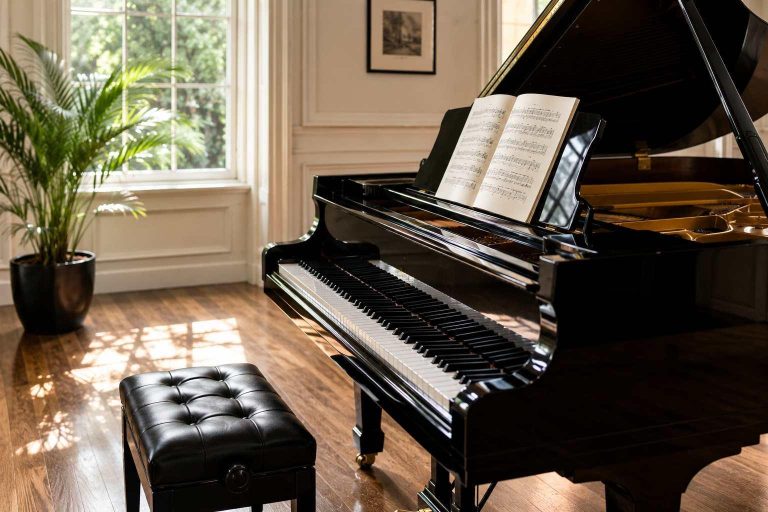
This is my first post
Beyond the Keys: How Piano Music Rewires the Brain and Transforms the Mind
What if a piano were more than a musical instrument? What if every note you played were also an opportunity to train your brain, sharpen your mind, and improve the way you understand the world?
Introduction: An Instrument for the Mind
A piano is more than a collection of black and white keys. It is an instrument that brings together creativity, discipline, emotion, and science. Behind every melody lies a remarkable process involving memory, attention, movement, hearing, and imagination.
When we play the piano, our brains coordinate multiple activities simultaneously. We read musical notation, recognize patterns, listen to different pitches, control our fingers, maintain rhythm, and anticipate what comes next. All these processes work together to transform written notes into music.
But what does this mean for the brain? Can learning the piano improve memory, concentration, and emotional well-being? Scientific research suggests that musical training can support several aspects of cognitive development and mental health. Although the benefits vary from person to person, the connection between music and the brain is genuinely fascinating.
1. A Workout for the Brain
Imagine trying to read a complicated passage of music while playing with both hands, keeping the rhythm steady, and listening carefully to every note. This is not a simple task. It requires the brain to process and coordinate several streams of information at once.
Piano playing engages numerous brain regions, including areas involved in hearing, movement, attention, and higher-level thinking. These regions communicate through complex neural networks, allowing the pianist to transform a musical idea into coordinated physical action.
One important concept behind this process is neuroplasticity—the brain's ability to change its connections and organization in response to learning and experience.
As a person practices the piano, the brain gradually adapts to the demands of the instrument. Musical patterns become more familiar, movements become more coordinated, and previously difficult passages may become easier to perform.
In this sense, learning the piano is not merely the acquisition of a musical skill. It is also an opportunity for the brain to adapt, develop, and refine its abilities.
2. Memory: Remembering More Than Notes
Playing the piano requires several forms of memory.
Working memory helps us hold information in mind temporarily, such as a musical phrase we are about to play. Long-term memory allows us to retain musical knowledge, techniques, and pieces over time. Meanwhile, procedural memory supports learned movements, such as familiar finger patterns.
Consider memorizing a piano sonata. You may need to remember its structure, recognize recurring themes, understand harmonic progressions, and coordinate the movements required to perform each passage.
With practice, some musical sequences become increasingly automatic, allowing the pianist to devote more attention to interpretation and expression.
Musical training has been associated with improvements in certain memory-related abilities, although these effects are not identical for everyone and do not guarantee better memory in every area of life.
Nevertheless, the process of learning, practicing, recalling, and refining music provides a rich environment for exercising different memory systems.
3. Concentration and the Art of Paying Attention
In a world full of notifications, distractions, and constant stimulation, sustained attention is an increasingly valuable skill.
Piano practice offers a structured opportunity to develop it.
When learning a new piece, a pianist must focus on pitch, rhythm, fingering, dynamics, articulation, and timing. A single passage may require repeated attempts before all its elements come together.
Effective practice also demands the ability to identify mistakes without becoming discouraged. Instead of simply repeating an entire piece, a skilled learner isolates a difficult section, examines the problem, and works on it systematically.
This approach encourages focused attention, error detection, and deliberate problem-solving.
Over time, regular piano practice may help strengthen habits of concentration that are useful in other learning situations. However, it is important to distinguish between practicing attention through music and proving that piano lessons automatically improve academic performance. Research supports some cognitive benefits of musical training, but the extent to which they transfer to unrelated tasks remains an active area of investigation.
4. Coordination: When Two Hands Think Together
One of the most remarkable features of piano playing is the coordination required between the hands.
The left hand may perform an accompaniment while the right hand plays a melody. The hands must follow different patterns while remaining synchronized in rhythm and expression.
At the same time, the eyes may move between the musical score and the keyboard, while the ears continuously monitor the sound.
This involves coordination between sensory information and movement. The brain must plan actions, adjust finger movements, respond to mistakes, and maintain the overall musical structure.
With practice, movements can become more precise and efficient. Pianists also develop a more detailed awareness of timing, touch, and the relationship between physical movement and sound.
These abilities are especially interesting because piano playing combines fine motor control with demanding intellectual and sensory tasks.
5. Creativity: Turning Notes into
Ideas
Music is not simply about following instructions. It is also about making choices.
Two pianists can perform the same composition and create noticeably different musical experiences. One may emphasize delicate phrasing, while another may highlight dramatic contrasts. Tempo, dynamics, articulation, and timing all influence how listeners experience a piece.
Playing the piano encourages musicians to explore these possibilities.
Improvisation takes this process even further. When improvising, a pianist generates musical ideas in real time, drawing on patterns, harmonic knowledge, imagination, and experience.
Composing offers another creative pathway. A musician can experiment with melodies, develop themes, build tension, and discover unexpected combinations of sounds.
These activities provide opportunities to practice flexible thinking and creative expression. They also demonstrate an important principle: creativity is not always a mysterious gift. It can be developed through experimentation, knowledge, and repeated practice.
6. Music and Emotional Well-Being
Music has a powerful relationship with human emotion.
A gentle melody may create a feeling of calm, while a dramatic passage can communicate excitement, tension, or sadness. The experience depends on the music, the listener, and the circumstances in which it is heard.
Playing the piano can provide a meaningful way to express emotions that are sometimes difficult to put into words. It can also offer a break from daily pressures, creating time for concentration and personal reflection.
Enjoyable musical activities may support relaxation and emotional well-being. Research into music-based interventions has also found benefits in certain contexts, although listening to music, playing an instrument for pleasure, and receiving structured music therapy are different activities.
It is therefore more accurate to say that piano playing can contribute to emotional well-being than to claim that it cures anxiety, depression, or other medical conditions.
Perhaps one of music's greatest strengths is that it gives emotion a form. A feeling that seems complicated or confusing can become a melody, a rhythm, or a sequence of chords.
7. Discipline, Patience, and the Power of Practice
Learning a musical instrument teaches an important lesson: improvement rarely happens all at once.
A difficult passage may require many attempts. A fast scale may initially feel uncomfortable, and a complicated rhythm may take time to understand. Progress often comes through small, consistent improvements rather than sudden breakthroughs.
Effective piano practice involves setting realistic goals, identifying weaknesses, receiving feedback, and adjusting one's approach.
These habits are closely related to self-regulated learning—the ability to plan, monitor, and improve one's own learning process.
For example, rather than attempting to play an entire difficult piece perfectly, a pianist might practice four measures slowly, focus on accurate fingering, and gradually increase the tempo when the passage becomes reliable.
This process demonstrates how complex goals can be divided into manageable steps.
The same general approach can be useful in many other activities, from learning mathematics to developing a new language or mastering a technical skill.
8. What Happens When We Learn Music at a Young Age?
Childhood and adolescence are important periods of brain development. During these years, the brain continues to refine its networks in response to experience, education, and the environment.
Learning an instrument during this period can provide rich opportunities to develop auditory perception, motor coordination, musical understanding, and attention.
Some studies have found associations between childhood musical training and differences in brain structure or function. Other research suggests benefits in particular cognitive or language-related tasks.
However, the scientific picture is complex. Children who receive music lessons may also differ in family support, educational opportunities, motivation, and other experiences. These factors make it difficult to attribute every observed difference directly to music.
The strongest conclusion is that learning the piano provides valuable musical, cognitive, and creative experiences during development. It should not be treated as a guaranteed shortcut to higher intelligence or superior academic results.
And there is no single age at which the opportunity disappears. Adults can also learn the piano and benefit from the challenge, enjoyment, and mental engagement it provides.
9. Does Playing the Piano Make You Smarter?
This is one of the most common questions about musical training.
The answer requires a distinction between becoming better at music and becoming better at every intellectual task.
Piano lessons clearly develop musical abilities, including pitch recognition, rhythmic understanding, performance technique, and the interpretation of musical structures. Research also suggests that musical training can influence certain cognitive skills.
However, evidence that these improvements consistently transfer to general intelligence, mathematics, or academic achievement is mixed. Musical training does not guarantee a higher IQ, and the effects depend on factors such as the type of training, the duration of practice, and the ability being measured.
Even so, the value of learning the piano does not depend on whether it increases intelligence.
It teaches a person to listen carefully, recognize patterns, interpret complex information, express ideas, and work persistently toward a goal. These are worthwhile skills in their own right.
10. How to Make Piano Practice More Beneficial
You do not need to practice for hours every day to make meaningful progress. What matters is the quality, consistency, and purpose of your practice.
Here are several practical strategies:
1. Set a clear objective. Choose one specific goal for each session, such as improving a difficult transition or mastering a rhythmic pattern.
2. Practice slowly. A controlled tempo makes it easier to notice mistakes and develop reliable technique.
3. Break difficult passages into smaller sections. Work on a few measures at a time before combining them into longer phrases.
4. Listen actively. Pay attention to tone, balance between the hands, rhythm, phrasing, and dynamics—not just whether you played the correct notes.
5. Challenge yourself gradually. Learn music that requires effort but remains achievable with practice.
6. Take breaks when necessary. Mental fatigue can make practice less effective. Short breaks can help you return with renewed attention.
7. Play music you enjoy. Classical sonatas, film soundtracks, jazz, pop arrangements, and original compositions can all provide motivation and opportunities to learn.
8. Reflect on your progress. Recording a performance occasionally can help you identify improvements and areas that need further work.
The goal is not simply to spend more time at the keyboard. It is to make that time meaningful.
Conclusion: Every Note Is an Opportunity to Learn
The piano occupies a unique position at the intersection of art and science. It engages the senses, challenges the mind, develops physical coordination, and creates opportunities for emotional expression.
Through regular practice, pianists learn to recognize patterns, manage attention, remember musical information, refine movements, and approach difficult tasks with patience. Research into musical training suggests that some of these experiences may also support broader cognitive abilities, although the extent of those benefits varies and should not be exaggerated.
Most importantly, playing the piano is valuable even beyond its measurable effects on the brain.
It gives us a language without words, a creative outlet for our thoughts, and a reminder that progress often emerges from patience and persistence.
So, the next time you sit in front of a piano, remember that you are doing more than pressing keys. You are learning to listen, to think, to create, and to communicate.
The piano may have 88 keys, but the possibilities it opens for the mind are far greater than a single number can express.
Further ReadingFor readers interested in the science behind music and the brain, the following sources provide useful starting points:
Harvard Medical School — Music and Health: Research and educational resources on the relationship between music, the brain, and well-being.
National Institutes of Health (NIH): Research publications on music, cognition, neuroplasticity, and human development.
Frontiers in Psychology: Peer-reviewed research on music cognition, musical learning, attention, and emotion.
Nature Reviews Neuroscience: Scientific perspectives on music perception, learning, and the neural systems involved in musical experience.
Scientific note: Musical training can support particular cognitive, motor, and emotional processes, but its effects vary. It should not be presented as a guaranteed method for increasing intelligence or treating medical conditions.